A lonely telescope in the Arizona desert tracks millions of distant galaxies to determine the ultimate fate of the Universe
South Korean: That could rewrite every physics textbook on Earth, a team of South Korean astronomers has published evidence suggesting the universe’s expansion is not just slowing down—it may be preparing to reverse.

These are thousands of galaxies captured by the Hubble Space Telescope. dark energy is driving them apart at ever increasing speed
Lead researcher Professor Young-Wook Lee of Yonsei University reported in the Monthly Notices of the Royal Astronomical Society that dark energy, the mysterious force previously thought to be pushing galaxies apart forever, appears to be weakening at a rapid rate.
For decades, the “Standard Model” of cosmology assumed the universe would end in a “Big Freeze,” becoming a cold, empty void. However, the new analysis of 300 galaxies indicates that the universe may have already entered a “decelerated phase.
” If dark energy continues to fade, the force of gravity will eventually take over, pulling all matter back together in a catastrophic “Big Crunch.”

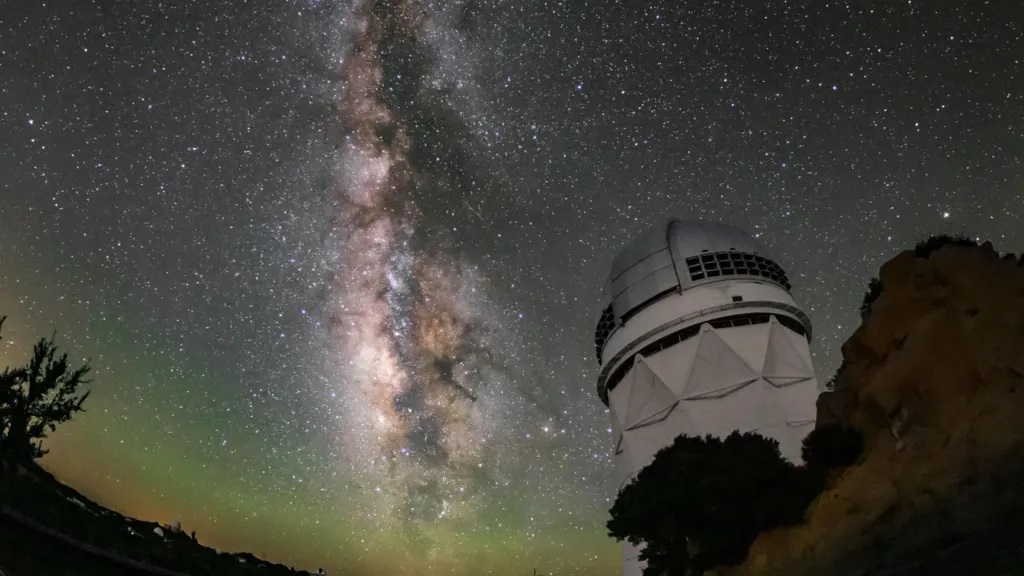
A cathedral for the cosmos an instrument inside this telescope can track the movement of 5,000 galaxies at a time
While critics from institutions like Cambridge University have expressed skepticism, calling the findings a result of “messy supernova data,” the South Korean team maintains their results have a “one-in-a-trillion” chance of being a fluke.
The global scientific community is now looking toward the upcoming Vera C. Rubin Observatory to provide a final verdict on whether our cosmos is destined for a fiery collapse.